Dog Scouts of America, Dog Troops Also Earn Badges and Go to Camp

Scouts, badges, troops and summer camp—they’re not just for kids anymore. Dog Scouts of America is a new twist on tradition that is fun for all ages.
Dogs, their owners and the larger community all benefit when a pet earns the basic Dog Scout certification badge. Any dog can participate, as long as he’s well-behaved. To qualify for the initial badge, he must be able to heel without pulling, greet a person calmly, meet another animal without overreacting and to see food and leave it alone. The test criteria are similar to that used for the Canine Good Citizen certificate from the American Kennel Club.Tests can be videotaped if there’s no organization evaluator in the area. Once the dog’s earned the basic Dog Scout badge, the rest of the badges are optional, depending on how involved human-canine pairs wish to get. Instead of pursuing a particular sport or activity, scouting allows the dog to dabble and find what he likes best. Distinctive badges can be earned in separate ability levels including obedience, community service, trail work, nose work, water sports, pulling, herding and lure coursing (a performance sport first developed for purebred sighthound breeds). Handlers can also earn badges in canine care, first-aid and sign language. All training is based on positive behavior and reinforcement on everyone’s part.
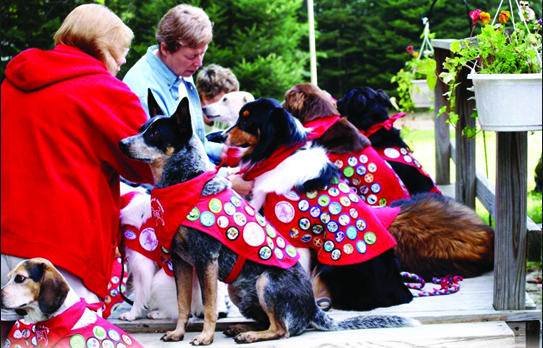 “We don’t want dogs to be an accessory or a lawn ornament; they are part of the family, and a lot of fun, besides,” explains Dog Scouts president Chris Puls, of Brookville, Indiana. “As trainers, we have to figure out how to communicate with another species.”
Most members engage in scout activities with more than one dog. Requirements for operating a troop are flexible, but holding four meetings a year is recommended. Meetings don’t have to be formal—a group hike in the woods counts. Other activities may include backpacking, biking, camping and treasure hunts like letterboxing and geocaching.
If Sparky would like to try flyball, (timed relay races with balls) or treibball (urban herding of Pilates balls), but has no opportunity for these pursuits on his home turf, summer camp is a good forum to investigate lots of options. Weekend camps are held in Maryland in July and Texas in November. Weeklong camps are held in Michigan in June and July.
“Many people bring more than one dog to camp,” says Allison Holloway, who works in financial account services for the U.S. Department of Defense, in Columbus, Ohio. “I take six dogs with me and each has his or her favorite activity, which I like, because it’s too much for one dog to go from early morning until late at night. New members often say they come to camp just for the fun and camaraderie, but they usually end up collecting badges like the rest of us. It’s a great reminder of what you and your dog did at camp together.”
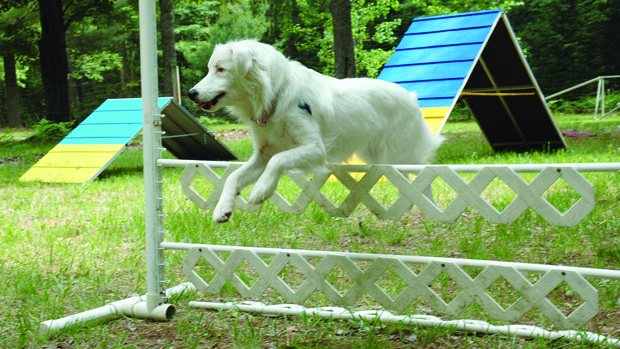 One of Holloway’s dog scouts has special needs. Lottie Moon is a double merle, all-white, Australian shepherd that doesn’t let being deaf or blind slow her down. Last year she surprised her owner by earning an agility badge at camp. “I think she sees shadows and movements. I place a dowel rod in front of the jump and she knows that when she touches it, it’s time go airborne,” says Holloway. “Lottie inspires and motivates me.” Holloway received the Dog Scout’s 2013 Excellence in Writing Award for her blog at Lottie-SeeingIntoDarkness.blogspot.com.
Many Dog Scout troops serve their communities to show how dogs can and should be integrated into daily life. In Wyoming Valley, near Wilkes-Barre, Pennsylvania, Phyllis Sinavage, office manager for a wholesale distributor, reports on recent activities conducted by Troop 221. “We’ve donated oxygen masks for pets to local fire departments and emergency services. We raise funds to buy them and also have oxygen mask angels that donate the price of a mask in memory of a pet. One third grade class raised enough money to purchase two masks after we visited and did a bite prevention class.”
The Dog Scouts of America Hike-a-Thon, in May, is the nonprofit organization’s annual fundraiser, open to everyone willing to ask friends and family members to pledge funds for distances walked. It’s a good way to partner with the dog for quality outdoor time, spread the word about Dog Scouts and enjoy the spring weather.
Learn more and join with others for a troop experience at DogScouts.org.
Connect with Sandra Murphy at [email protected].
